After editing hundreds of romance manuscripts, I can spot cringe-worthy dialogue from a mile away. You know the type—those over-the-top declarations that make readers roll their eyes instead of swoon. The good news? Writing believable romance dialogue isn't a mysterious talent reserved for bestselling authors. It's a skill you can develop with the right approach.
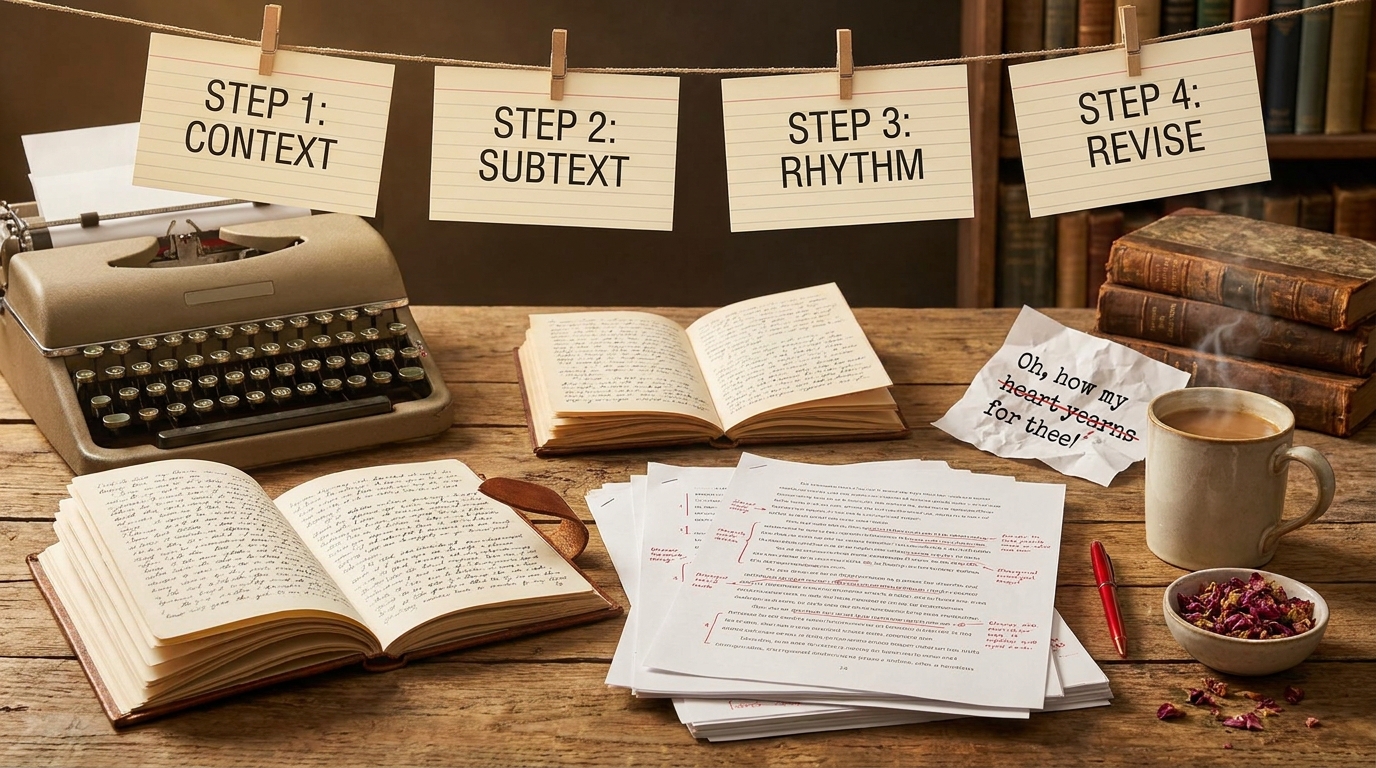
Today, I'm sharing my four-step system for transforming stilted, melodramatic conversations into authentic exchanges that make readers fall in love alongside your characters. These techniques have helped countless authors move from "purple prose" to "page-turner," and they'll work for you too.
Step 1: Master the Subtext Layer
The most powerful romantic dialogue happens beneath the surface. In manuscripts I edit, I often see authors having their characters say exactly what they mean, exactly when they mean it. But real people—especially people falling in love—rarely work that way.
Consider this common problematic example I encounter:
"I love you so much, Sarah. You're the most beautiful woman I've ever seen, and I can't live without you."
While sincere, this lacks the tension and authenticity that make romance dialogue compelling. Here's how subtext transforms it:
"You're going to be late for work." He handed her the coffee mug, their fingers brushing. "I made it the way you like it."
The subtext here screams "I love you" without saying it directly. He knows how she takes her coffee. He's thinking about her needs. The simple gesture carries more romantic weight than a flowery declaration.
Practical Subtext Techniques
- Use deflection: Characters avoid vulnerable topics by changing the subject
- Employ coded language: Develop unique phrases or references only your characters understand
- Show care through details: Characters notice and respond to small things about each other
- Create meaningful interruptions: What characters almost say can be more powerful than what they do say
Step 2: Maintain Voice Consistency During Emotional Scenes
This is where I see even experienced authors stumble. A character who's been speaking in short, practical sentences suddenly launches into Shakespearean soliloquies when emotions run high. Writing believable romance dialogue means your characters stay true to themselves, especially during pivotal moments.
I recently edited a manuscript where a taciturn mechanic suddenly declared: "My darling, you illuminate my very soul with your radiant presence." The author was trying to show his deep feelings, but it completely broke character.
Instead, we revised it to: "You... you make everything better. Don't know how, but you do." This maintains his hesitant speech pattern while still conveying profound emotion.
Voice Consistency Checklist
- Sentence length: Does your character typically use short, clipped sentences or longer, flowing ones?
- Vocabulary choices: A small-town teacher and a Wall Street executive won't use the same words
- Emotional expression: Some people get quieter when emotional, others become more talkative
- Cultural background: Consider how your character's upbringing influences their speech patterns
Step 3: Deploy the Purple Prose Detector
Purple prose in dialogue is like wearing a ballgown to the grocery store—it draws attention for all the wrong reasons. In romance manuscripts, I regularly encounter dialogue so overwrought it inadvertently becomes comedic.
Here are the red flags I watch for:
Common Purple Prose Patterns
- Excessive adjectives: "Your magnificent, ethereal, breathtaking beauty" should simply be "You're beautiful"
- Unnatural vocabulary: People rarely say "pectorals" in intimate moments—"chest" works just fine
- Over-dramatic metaphors: "You're the sun to my moon, the ocean to my shore" sounds like a greeting card
- Instant poetry: Characters shouldn't suddenly become Byron unless they're actually poets
The fix isn't to eliminate all romantic language—it's to make it feel natural. Instead of "You've captured my heart like a butterfly in amber," try "I can't stop thinking about you." The simpler version feels more genuine and relatable.
The Purple Prose Test
Read your dialogue aloud. If you feel embarrassed saying it, your readers will feel embarrassed reading it. Better yet, imagine your characters as real people you know. Would your tough construction worker hero really say "divine goddess" in bed? Probably not.
Step 4: Perfect Rhythm and Pacing
Natural conversation has rhythm—a flow of give and take that mimics real speech patterns. When writing believable romance dialogue, you need to consider not just what characters say, but how the conversation moves.
I often see manuscripts where every exchange follows the same pattern: Character A says something, Character B responds at equal length, Character A replies with another lengthy response. Real conversations don't work this way.
Creating Natural Flow
Vary response lengths: Mix short reactions ("What?" "Really?" "Oh.") with longer explanations. This creates a more natural rhythm.
Use interruptions strategically: People interrupt each other, especially during emotional conversations. But use this technique sparingly—too many interruptions become annoying.
Include thinking pauses: Characters need time to process information. "She stared at him for a long moment" gives weight to what comes next.
Employ overlapping dialogue: Sometimes characters talk past each other, especially during arguments or misunderstandings.
The Rhythm Exercise
Take a page of your dialogue and mark it like sheet music. Note where you have fast exchanges (short, quick responses), slow movements (longer, thoughtful responses), and pauses (beats of action or reflection). Good romantic dialogue needs variety in tempo.
Bringing It All Together
Writing believable romance dialogue is about finding the sweet spot between authentic human speech and the heightened emotion that makes romance compelling. Your characters should sound like real people, but real people at their most interesting moments.
The best romantic dialogue I edit combines all four elements: it operates on multiple levels through subtext, stays true to character voice, avoids purple prose pitfalls, and flows with natural rhythm. When you master these techniques, your dialogue will draw readers deeper into your story instead of pulling them out of it.
Start with one conversation in your current manuscript. Apply these four steps systematically. You'll be amazed at how much stronger your dialogue becomes, and more importantly, how much more your readers will connect with your characters' love story.
Remember, every bestselling author started exactly where you are now. The difference isn't talent—it's the willingness to learn, practice, and refine your craft. Your authentic voice is in there, waiting to emerge. These techniques will help you find it.
Frequently Asked Questions
How can I tell if my romance dialogue sounds too cheesy?
Read your dialogue aloud—if you feel embarrassed saying it, readers will feel embarrassed reading it. Also watch for excessive adjectives, unnatural vocabulary, and over-dramatic metaphors that sound more like greeting cards than real conversation.
What's the biggest mistake authors make with romantic dialogue?
Having characters say exactly what they mean without subtext. Real people, especially those falling in love, communicate as much through what they don't say as what they do say.
How do I keep my characters' voices consistent during emotional scenes?
Remember that intense emotions don't completely change how someone speaks. A quiet character might say less but feel more, while a talkative character might ramble when nervous.
Should I eliminate all flowery language from romance dialogue?
No, but make it feel natural to your specific characters. A poet might speak more lyrically than a mechanic, but both can express deep emotion authentically within their own speech patterns.
Ready to Take Your Manuscript to the Next Level?
As a developmental editor specializing in romance fiction, I help authors strengthen their stories, deepen their characters, and polish their prose. Let's work together to make your book shine.
Learn About My Editing Services →