Why Word Count Matters More Than You Think
As an editor who's worked with hundreds of romance manuscripts, I can tell you that nothing screams "amateur" quite like a 200,000-word contemporary romance or a 30,000-word historical. While your story's heart matters most, getting the length right is your first step toward professional credibility.
Publishers, agents, and even readers have expectations about romance novel word count guidelines—and straying too far from these norms can kill your chances before anyone reads page one. But here's the good news: once you understand these industry standards, you can craft a manuscript that fits perfectly within market expectations while still telling your unique story.
Romance Novel Word Count Guidelines by Subgenre
Contemporary Romance
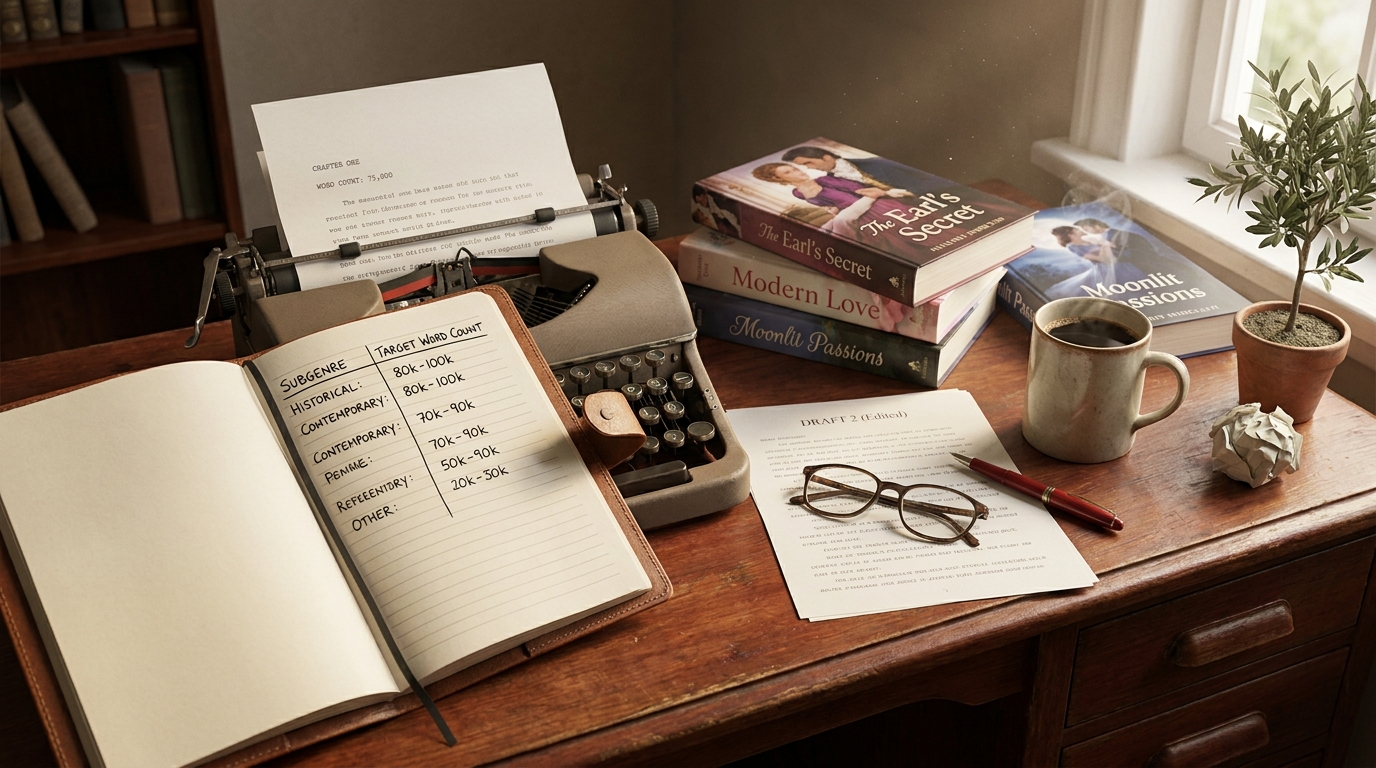
The sweet spot for contemporary romance sits between 50,000-90,000 words, with most successful novels landing around 70,000-80,000 words. Think of bestsellers like The Hating Game by Sally Thorne (around 85,000 words) or Beach Read by Emily Henry (approximately 75,000 words).
In manuscripts I edit, I often see new authors cramming multiple relationship arcs and subplots into contemporary romance, pushing word counts over 100,000. While ambition is admirable, contemporary readers expect a focused, streamlined story that moves at a brisk pace.
Historical Romance
Historical romance gets more breathing room, typically ranging from 75,000-100,000 words. The additional length accommodates world-building, historical context, and the more formal courtship patterns that define the subgenre.
Authors like Julia Quinn and Lisa Kleypas consistently hit this target, with most of their novels falling between 85,000-95,000 words. However, I regularly see debut historical romance manuscripts bloated to 120,000+ words with excessive historical detail that slows pacing to a crawl.
Paranormal Romance
Paranormal romance offers the most flexibility, with successful novels ranging from 60,000-120,000 words. Urban fantasy romance can push toward the higher end, while paranormal contemporary typically stays closer to 70,000-90,000 words.
The key here is justifying your length. If you're writing a complex world with multiple supernatural species, political systems, and magic rules, 100,000 words might be necessary. But if your paranormal element is simply "he's a vampire," aim for the lower end of the range.
Erotic Romance
Erotic romance typically runs 50,000-80,000 words, though this can vary significantly based on heat level and complexity. BDSM romance often requires additional length for proper negotiation scenes and relationship development, while straightforward erotic romance can succeed at shorter lengths.
What matters most in erotic romance isn't just the steam—it's the emotional journey. I've edited brilliant 60,000-word erotic romances with incredible character development and bloated 90,000-word manuscripts where the extra length added nothing but redundant sex scenes.
Why Straying from Romance Novel Word Count Guidelines Hurts Your Chances
Agent and Publisher Expectations
Agents receive hundreds of queries monthly, and many automatically pass on manuscripts that fall outside expected word count ranges. A 40,000-word historical romance or 150,000-word contemporary signals to industry professionals that you don't understand market expectations.
This isn't arbitrary gatekeeping—it's economics. Publishers know what length works for their audience, printing costs, and shelf space. A romance novel that's too long increases printing costs and cover price, potentially pricing it out of its market.
Reader Expectations
Romance readers are incredibly genre-savvy. They expect certain pacing, emotional beats, and story structures within specific word count ranges. A 120,000-word contemporary romance raises questions: Is it really romance, or women's fiction with romantic elements? Will the pacing drag?
Similarly, a 45,000-word historical romance might feel rushed, without adequate time for proper courtship or world-building that historical romance readers crave.
How to Trim Bloated Manuscripts Without Losing Heart
Target Secondary Characters First
In manuscripts I edit, excess length often comes from overworked secondary characters and subplots that don't serve the central romance. Ask yourself: does every scene advance the romantic relationship or reveal crucial character development? If not, it's probably padding.
Cut ruthlessly, but preserve the emotional core. That 2,000-word scene of your heroine bonding with her sister might be beautifully written, but if it doesn't impact her relationship with the hero, it's taking up valuable real estate.
Streamline Backstory and World-building
New authors often front-load exposition, especially in historical and paranormal romance. Instead of three paragraphs explaining your magic system, weave that information naturally through dialogue and action. Show the heroine using magic rather than explaining how magic works.
Historical authors particularly struggle here. Your research is impressive, but readers don't need every detail about 19th-century textile manufacturing unless it directly impacts your characters' relationship.
Tighten Dialogue Tags and Action Beats
Look for repetitive dialogue patterns and excessive action beats. Instead of:
"I don't understand," she said, shaking her head in confusion while her brow furrowed with worry.
Try:
"I don't understand." She shook her head.
These small cuts add up quickly without losing emotional impact.
Series vs. Standalone: Different Rules Apply
Series romance often allows for slightly longer individual books, especially in paranormal and fantasy romance, because you're building a world that will support multiple novels. However, your first book still needs to work as a complete story arc.
I've seen authors justify excessive length in book one by saying "it's world-building for the series." This is dangerous thinking. Each book must deliver a satisfying romance within appropriate word count parameters. Readers won't stick around for book two if book one feels bloated or incomplete.
Standalone novels need to be more disciplined about length because you have one shot to deliver a complete, satisfying story within market expectations.
The Reality Check: When Your Story Demands Different Length
Sometimes, despite your best efforts, your story genuinely needs more or fewer words than standard romance novel word count guidelines suggest. Before you decide you're the exception, ask yourself honest questions:
- Have I justified every scene's existence?
- Does additional length serve the romance, or just my attachment to certain scenes?
- Would this story work better in a different subgenre with more flexible length expectations?
If you're still convinced your story needs non-standard length, make sure every extra word earns its place. Exceptional stories can break rules, but they need to be truly exceptional.
Your Word Count Is a Professional Tool
Remember, adhering to word count guidelines isn't about limiting your creativity—it's about demonstrating your professionalism and understanding of your chosen market. Romance readers and industry professionals have these expectations for good reasons, developed through decades of successful publishing.
Every successful romance author has worked within these constraints while still creating unique, compelling stories. Your voice and creativity will shine through regardless of whether your manuscript is 75,000 or 85,000 words. Focus on making every word count, and you'll find that working within these parameters actually strengthens your storytelling rather than constraining it.
The journey to publication is challenging enough without self-sabotaging through inappropriate length. Get your word count right, and you're one step closer to getting your romance into readers' hands—which is where it belongs.
Frequently Asked Questions
What is the ideal word count for contemporary romance novels?
Contemporary romance novels should typically be between 50,000-90,000 words, with most successful novels falling in the 70,000-80,000 word range. This length allows for proper character development and romantic arc without excessive padding.
Can romance novels be too short for traditional publishing?
Yes, romance novels under 50,000 words are generally considered too short for traditional publishing in most subgenres. Publishers and agents expect certain minimum lengths to justify print costs and meet reader expectations for value.
How long should historical romance novels be compared to contemporary?
Historical romance novels are typically longer than contemporary, ranging from 75,000-100,000 words. The extra length accommodates necessary world-building, historical context, and the more elaborate courtship patterns expected in historical settings.
Do romance series have different word count requirements than standalone novels?
Romance series may allow slightly more flexibility in length, especially for world-building in paranormal or fantasy romance. However, each book must still deliver a complete romantic arc within appropriate subgenre parameters and work as a satisfying standalone story.
Ready to Take Your Manuscript to the Next Level?
As a developmental editor specializing in romance fiction, I help authors strengthen their stories, deepen their characters, and polish their prose. Let's work together to make your book shine.
Learn About My Editing Services →