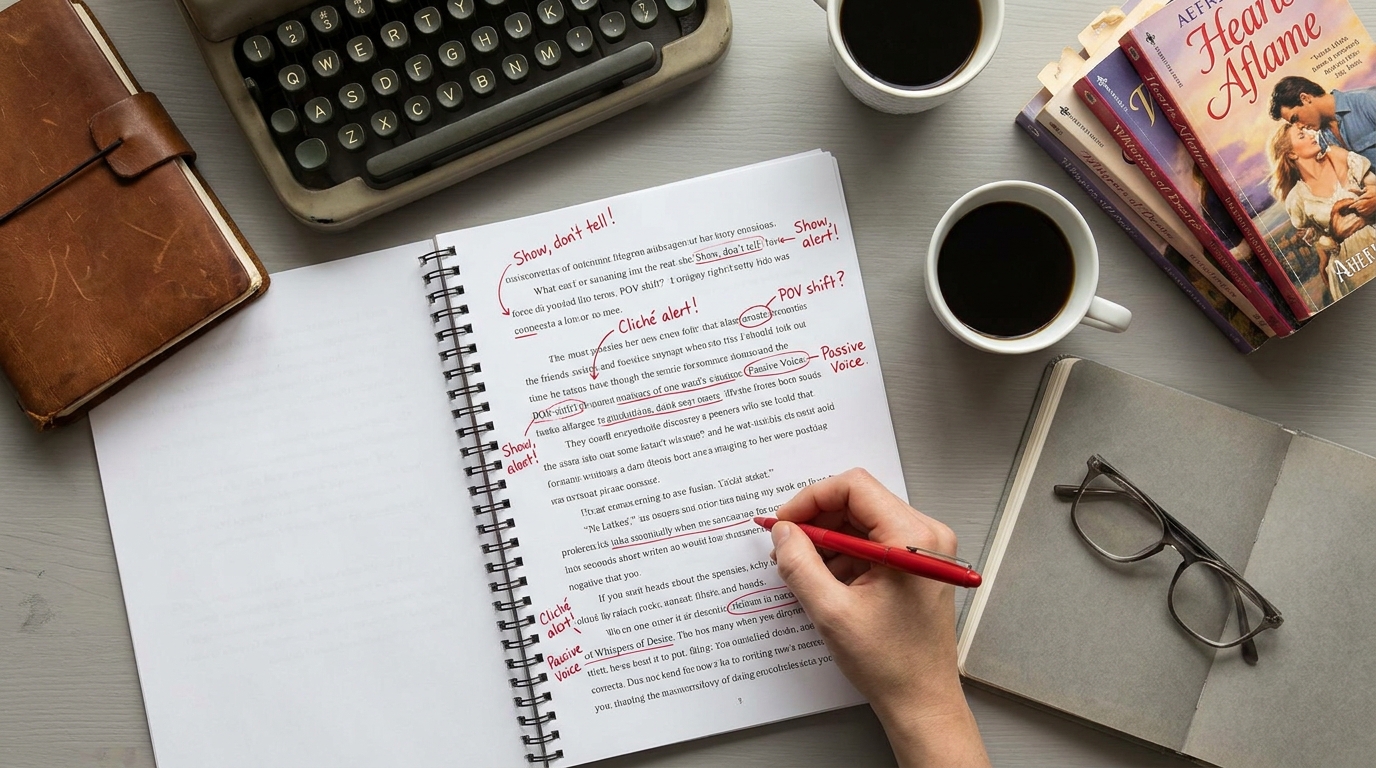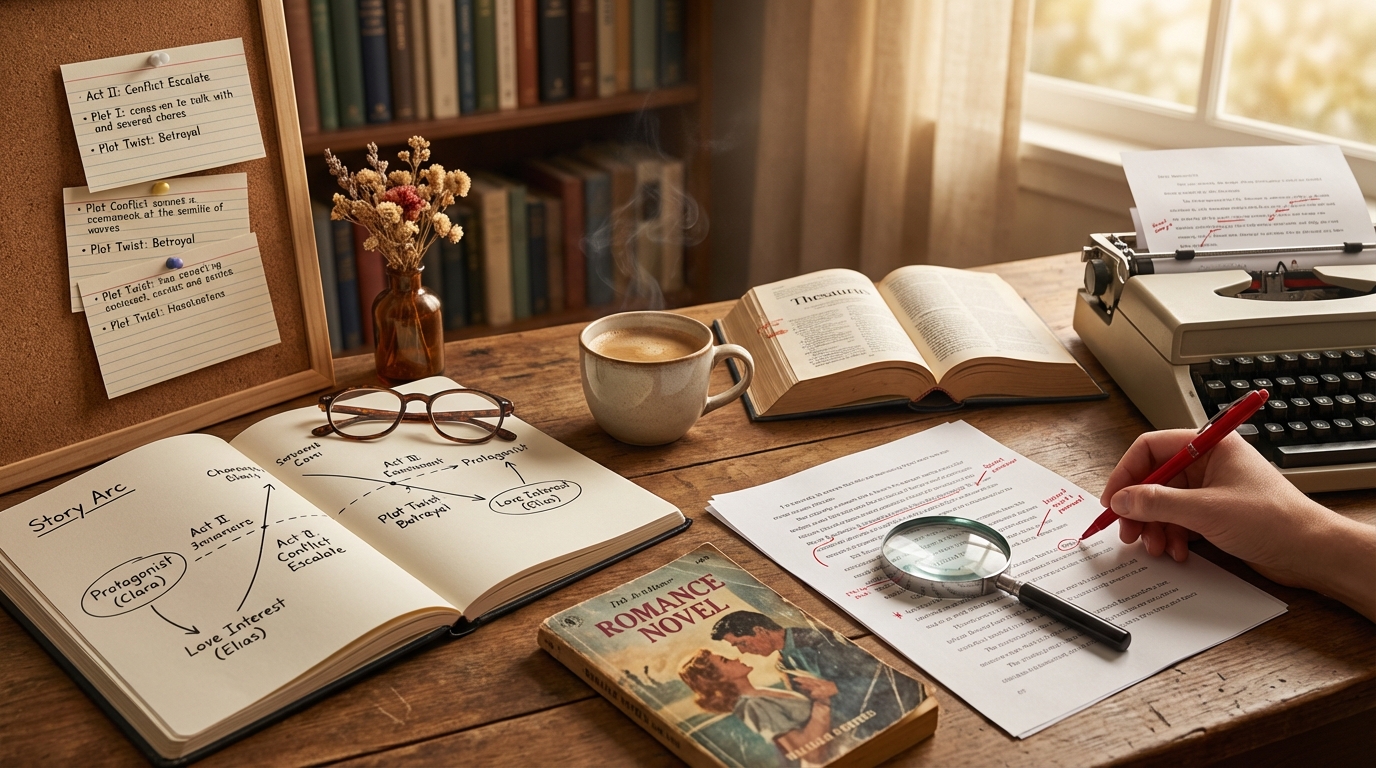
As a developmental editor who's worked with countless romance authors, I've learned to spot the telltale signs that a manuscript needs more work before it's ready for professional editing. While every writer's journey is different, there are certain red flags that consistently signal a story isn't quite there yet.
Don't get me wrong—recognizing these issues doesn't mean you're a bad writer. It means you're developing the critical eye that separates published authors from aspiring ones. The key is knowing when your romance manuscript ready for editor review, and when it needs a bit more self-editing first.
Here are five major red flags I see repeatedly, along with practical steps to address them before you invest in professional editing services.
Red Flag #1: Incomplete Character Arcs and Weak Motivation
In manuscripts I edit, I often encounter protagonists who feel more like plot devices than real people. Your hero might be described as "brooding and mysterious," but if I can't understand why he's brooding or what drives his choices, there's work to be done.
Character motivation is the engine of romance. When I read a scene where the heroine suddenly decides to trust the hero after 200 pages of justified suspicion, but there's no clear emotional journey that led to this moment, I know the character arc needs strengthening.
How to Fix This Before Editing
- Map each character's emotional journey: Write a one-paragraph summary of how each main character changes from chapter one to the end
- Question every major decision: Can you explain why your protagonist makes each significant choice based on their established personality and goals?
- Check for growth moments: Identify at least three scenes where your characters learn something new about themselves or each other
Red Flag #2: Pacing Problems with Romantic Tension
Pacing in romance is like a dance—there should be a natural rhythm of advance and retreat, tension and release. I've seen manuscripts where the couple goes from enemies to lovers in two chapters, and others where they're still awkwardly shaking hands at the 75% mark.
The most common pacing issue I encounter is the "sagging middle," where romantic tension plateaus instead of building. Your characters might have great chemistry in early scenes, but if that spark isn't consistently challenged and deepened throughout the story, readers will lose interest.
Signs Your Pacing Needs Work
- Major romantic developments feel rushed or unearned
- Multiple chapters pass without meaningful romantic progression
- The emotional stakes feel the same in chapter five as in chapter fifteen
- Secondary plots overshadow the romantic storyline
Quick Pacing Fixes
Read through your manuscript and highlight every scene that advances the romantic relationship. If you're seeing big gaps, you need more meaningful interactions between your leads. Consider what internal or external conflicts could create new obstacles just when things seem to be going smoothly.
Red Flag #3: Unresolved Plot Holes in the Main Storyline
Plot holes are different from minor continuity errors. I'm talking about fundamental logic gaps that make readers question the entire premise. Maybe your heroine's supposedly devastating secret wouldn't actually matter to anyone, or your hero's grand gesture contradicts everything we know about his character.
In romance, plot holes often center around the central conflict keeping the couple apart. If the obstacles between your protagonists could be resolved with one honest conversation, you need stronger external or internal conflicts.
Common Plot Holes I See
- The easily resolved misunderstanding: Conflict that persists only because characters refuse to communicate like adults
- The convenient coincidence: Major plot points that rely on implausible timing or circumstances
- The character amnesia: Protagonists who forget important information when it's convenient for the plot
Before determining if your romance manuscript ready for editor review, ask beta readers or critique partners to identify anything that doesn't make sense. Fresh eyes catch plot holes that writers, deeply embedded in their story world, often miss.
Red Flag #4: Inconsistent POV and Voice Issues
Point of view problems can derail even the most compelling romance. I've edited manuscripts where the POV shifts unexpectedly mid-scene, or where both protagonists sound exactly alike despite supposedly having distinct personalities and backgrounds.
Voice consistency is particularly crucial in dual POV romances. Your small-town baker shouldn't sound like your billionaire CEO when they're narrating their respective chapters. Each character needs distinct thought patterns, vocabulary, and ways of processing the world.
POV Red Flags to Watch For
- Head-hopping within scenes (switching between characters' thoughts without clear breaks)
- Characters knowing information they shouldn't have access to
- Identical "voice" regardless of which character is narrating
- Inconsistent depth—some scenes feel intimate and internal while others remain surface-level
Read your manuscript aloud, paying attention to whether you can identify which character is speaking or thinking without looking at chapter headings. If all your characters sound the same, spend time developing their distinct voices before moving forward.
Red Flag #5: Missing Emotional Beats in Key Romantic Scenes
This is perhaps the most heartbreaking issue I encounter—manuscripts with solid plots and likeable characters that fall flat because the emotional beats are missing. The first kiss happens, but we don't feel the characters' internal experience. The love confession occurs, but it reads more like a plot checkpoint than an emotional revelation.
Romance readers are looking for emotional satisfaction. They want to feel the butterfly flutter of new attraction, the ache of longing, the triumph of love overcoming obstacles. If your pivotal romantic scenes read like a sequence of events rather than emotional experiences, your manuscript isn't ready yet.
Essential Emotional Beats to Include
- The recognition moment: When characters first see each other as potential romantic partners
- The vulnerability reveal: When characters share something meaningful about themselves
- The point of no return: When characters realize their feelings have deepened beyond casual attraction
- The dark moment: When it seems like love won't be enough to overcome the obstacles
- The emotional climax: When characters choose love despite the risks
Making Sure Your Romance Manuscript Ready for Editor
Before you decide your romance manuscript ready for editor evaluation, take time to address these fundamental issues. Professional editing works best when it can focus on polishing and enhancing a solid foundation, rather than rebuilding from the ground up.
Remember, recognizing these red flags isn't about perfection—it's about readiness. Your manuscript doesn't need to be flawless, but it should be structurally sound with clear character arcs, consistent pacing, logical plot progression, stable POV, and emotionally resonant romantic beats.
The revision process can feel overwhelming, but every published author has walked this path. Each draft gets you closer to the story you're meant to tell. Trust the process, be patient with yourself, and remember that great romance novels aren't written—they're rewritten.
Frequently Asked Questions
How do I know when my romance manuscript is ready for professional editing?
Your manuscript is ready when it has complete character arcs, consistent pacing, resolved major plot holes, stable POV, and strong emotional beats in key romantic scenes. Beta reader feedback can help identify remaining structural issues.
Should I hire an editor if my romance novel has major plot holes?
It's better to address significant plot holes through self-editing or beta reader feedback first. Professional editing works best on structurally sound manuscripts that need polishing rather than major reconstruction.
What's the difference between developmental editing and copy editing for romance novels?
Developmental editing focuses on big-picture elements like character development, plot structure, and pacing. Copy editing addresses grammar, style, and sentence-level issues after the story structure is solid.
How can I fix pacing problems in my romance manuscript?
Map out your romantic tension beats throughout the story, ensure each chapter advances the relationship meaningfully, and create new obstacles when the emotional stakes start to plateau.
Ready to Take Your Manuscript to the Next Level?
As a developmental editor specializing in romance fiction, I help authors strengthen their stories, deepen their characters, and polish their prose. Let's work together to make your book shine.
Learn About My Editing Services →